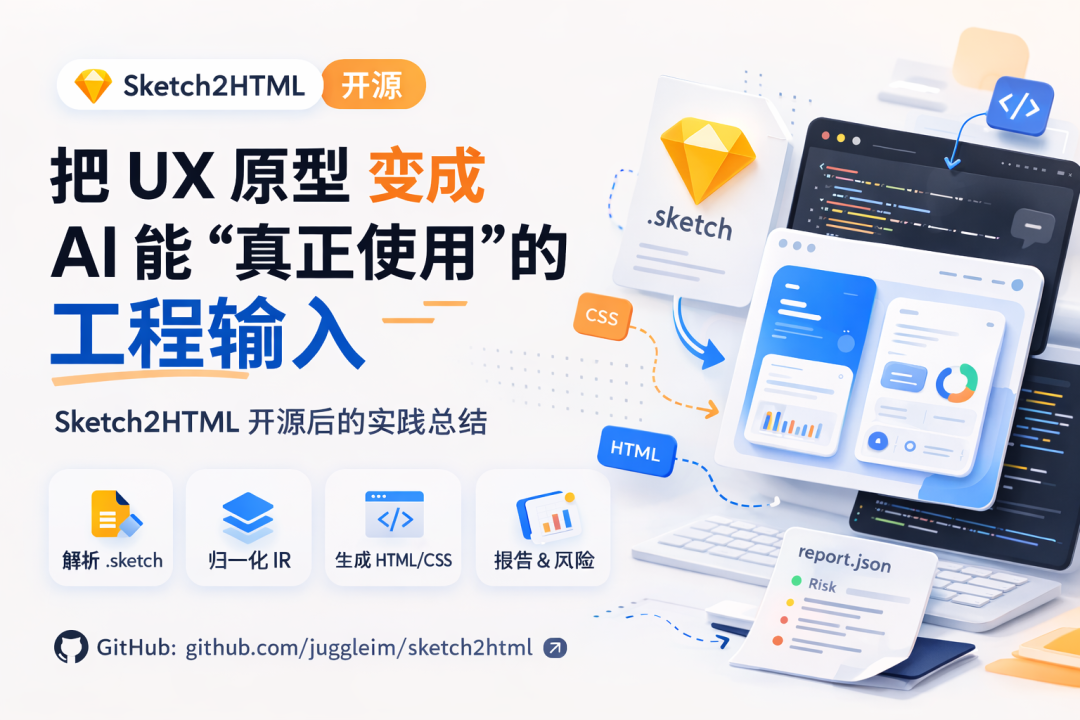
Turning UX Prototypes into Engineering Input That AI Can Actually Use
These past two years everyone's been talking about AI programming productivity, but frontline teams quickly run into the same real problem: AI can write code, but it often can't "read" the design.
You feed the PRD, screenshots, and a few descriptions into the model. It can write out the page structure, but it has a hard time stably reproducing the visual details. You ask it to manually describe Figma/Sketch, and it tends to drift on details like size, font, corner radius, and icons. The result: the front-end keeps changing things, design keeps re-reviewing, and the value AI generates is offset by a lot of rework.
The sketch2html project is essentially about solving this gap: converting .sketch files into a set of previewable, traceable static artifacts (HTML + CSS + PNG/SVG/fonts + report) that AI can continue to consume — and without depending on Sketch App or sketchtool. It isn't "yet another front-end framework"; it turns the design input into a middleware layer that can flow automatically in engineering.
———
1. The Bottom Line: In the AI Programming Era, What's Missing Isn't "Generation Ability" but "Consumable Design Semantics"
For many teams, the problem isn't "the model isn't smart enough" — it's that the input isn't engineered enough. A prototype is intuitive to a human designer, but to AI it's often just pixel reference. Without structured output, the model struggles to stably map visual constraints to code constraints.
The core value of sketch2html isn't "exporting a page to look at" — it does three things that are critical to automation:
- Turns the design file into a deterministic, repeatable build process (inspect + build).
- Normalizes visual elements into a renderable intermediate representation (IR), then outputs HTML/CSS/assets.
- Explicitly writes risks and degradations into
report.json, avoiding "looks successful but actually mines a landmine".
These three things together are the prerequisite for AI to handle real-world design files.
———
2. What Problems Does It Actually Solve?
1) Information loss between design and code
In the traditional process, the design goes through "human understanding → human rewrite → human fix". Each step can lose information. sketch2html directly parses the .sketch compressed structure, enumerates pages/artboards, and extracts layers, styles, fonts, bitmaps, and vectors — reducing the loss from intermediate verbal descriptions.
2) The lack of an "auditable mechanism" for restoration quality
Many tools only output a page, without telling you where things were degraded. This project outputs report.json, including checks like vectorPathOverflow, making "risk" explicit instead of implicit.
3) The automation pipeline isn't reusable
A one-time export is easy, but stably integrating it into CI/CD over the long term is hard. The project provides a portable distribution capability (npm run build:portable) that packages runtime dependencies, reducing the cost of reproducing across machines.
———
3. Why Is This Technical Approach Worth Pursuing?
The project takes a "compiler-style" approach: Reader (read) → Normalizer (normalize) → Renderer (render) → Emitter (artifact output) → Diagnostics (diagnostic report).
This approach has several very practical engineering advantages:
- It's not a "black-box screenshot-to-code" — there's a middle layer that can be inspected and iterated.
- It can clearly support boundaries: prioritize high-fidelity static export, without promising automatic generation of business-semantic components.
- It can evolve continuously: today, focus on restoration and auditing; tomorrow, integrate AI's second-pass generation and business refactoring.
In other words, it doesn't replace the front-end in one step. Instead, it first does the most painful, most foundational thing well — "standardizing design input".
———
4. A Few Engineering Points in the Project I Find Critical
1) Inspect first: risk-check before export
inspect outputs page/artboard info, layer-type statistics, and risk characteristics (blur, mask, blendMode, symbolInstance, etc.). This step is a lot like a "feasibility pre-review", letting the team know in advance which areas may be high risk before building, instead of exporting blindly.
2) IR normalization: translating Sketch's structure into a renderable language
Internally, the project normalizes layers into a unified node model (container, text, bitmap, vector, etc.) and handles symbol instance expansion, style mapping, and text segmentation. This IR layer is especially valuable to AI because it's closer to "the code world's expression" than the raw design JSON.
3) Hybrid rendering strategy: CSS where possible, SVG/PNG for the complex stuff
Elements that can be stably expressed go to HTML/CSS; complex vectors or small icons are rasterized under certain conditions, default @4x, with 2/4/8 available. This isn't a compromise — it's a pragmatic engineering choice for "cross-end consistency": better a controlled degradation than random distortion.
4) Font and rich-text handling: avoiding "looks right, but isn't"
The project normalizes font descriptions and auto-generates @font-face; text supports segmented color styles. These details look small, but they are exactly where AI-generated UI drifts the most.
5) Report-driven quality closed loop
The end of an export is not "task complete" — it's "in a checkable state": you can use report.json to locate the problematic nodes, then decide whether to fix the design source, adjust export parameters, or add constraints during AI's second-pass generation.
———
5. The Significance of SKILL Automation: From "Knowing How to Use a Tool" to "Replicable Process"
The project also provides skills/sketch2html-cli. This is a critical point. It distills the knowledge of "how to install, how to inspect, how to build, how to distribute" into a reusable workflow, rather than letting it live in verbal experience.
In AI-collaborative development, SKILL automation has three layers of value:
- Standardized entry point: every run starts from the same process, reducing randomness.
- Lower cognitive load: new joiners or cross-functional members can get started quickly, without relying on "veterans to lead the way".
- Improved operability: once the process is solidified, it can be reliably integrated into scripts, CI, and release pipelines.
Many teams don't use AI well not because of the model, but because they haven't codified the "collaboration protocol between people and tools". SKILL is filling that protocol layer.
———
6. How to Land This in a Real Team?
I recommend the following lightweight pipeline:
- Design side outputs the baseline version of the
.sketchfile. - The dev side first runs
inspectand looks at the risk statistics. - Then runs
buildto produce the static package and report. - Feed HTML/CSS/assets +
report.jsonas context to AI. - Let AI generate target-stack code (React / Vue / mini-program, etc.) based on this "structured design fact".
- Humans only do the semantic and business-interaction completion, not handwriting styles from scratch.
This shifts the team's energy from "does it look like" to "is it usable, is it maintainable".
———
7. Boundaries Need to Be Clear: It's Not a Silver Bullet, but It's a Solid Foundation
sketch2html's positioning is very restrained: prioritize high-fidelity static export, no promise of complex business semantics and automatic interaction generation. I think that's actually a sign of its reliability. In engineering practice, the worst thing is "promising everything, then being uncontrollable".
A truly sustainable AI engineering path usually advances in layers:
- Layer 1: standardize and make design input checkable (what this project is doing).
- Layer 2: feed the standardized output to AI for target-framework code generation.
- Layer 3: turn business semantics, state management, and interface orchestration into team-templated capabilities.
If Layer 1 is solid, Layers 2 and 3 won't have to keep being redone.
———
8. Final Thoughts: Open Source Really Frees Up "Collaboration Efficiency"
What struck me most about this open-source release is this: we should no longer think of "design-to-code" as a manual task for some front-end engineer — we should upgrade it to a standard compile step in the engineering system.
When UX prototypes can be stably converted into AI-consumable structured content, three things change in team collaboration:
- Design and development no longer rely on "verbal translation" to pass details.
- AI no longer just "guesses pages" — it can "generate based on facts".
- Delivery goes from a one-time output to an iterable, traceable, automatable pipeline.
If you're also working on landing AI programming, I'd suggest not chasing "one-click generation of a complete business system" first — get the input layer polished first. sketch2html provides a very pragmatic starting point: define the problem clearly first, then use a tool to solve the problem stably.
(Open-source URL: https://github.com/juggleim/sketch2html)